A real-time projection mapping configurator mounted on a 1:18 scale Porsche 911 GT3 model.
TouchDesigner + Blender + Xbox Kinect — gesture-driven, physically present,
emotionally resonant. The digital showroom experience, collapsed back into a room you can touch.
ContextImmersive Space Design
TeamSpandan Sarkar, Anurag Alladi, Ankit Kachhap
My RoleIxD + TouchDesigner + UI Design
StackTouchDesigner · Blender · Kinect · Figma
Year2025
01 — The Problem
Why does Porsche customization feel overwhelming and emotionally diluted?
The Porsche showroom redirects buyers to a website for configuration — a process that can be done from any couch at home. The physical presence of the car is stripped of its purpose. Meanwhile, 180+ colour options and nested configuration menus make the process feel like filing a form, not buying a dream.
ISSUE 01
Digital Shift in Showroom Experience
The showroom redirects to a website for configuration, stripping the physical space of its unique value. A premium experience that could happen anywhere loses its edge.
ISSUE 02
Overwhelming Customization Options
With 180+ colours and hundreds of configurations, the system becomes hard to navigate and nearly impossible to visualize as a single, coherent outcome.
ISSUE 03
Loss of Emotional Luxury Impact
Instead of feeling exciting and premium, the process feels heavy and fragmented — reducing the emotional gravity of what should be one of the most significant purchases of a person's life.
"The process felt like ordering from a menu, not building something you'd dreamed about."
— Core design insight from showroom observation
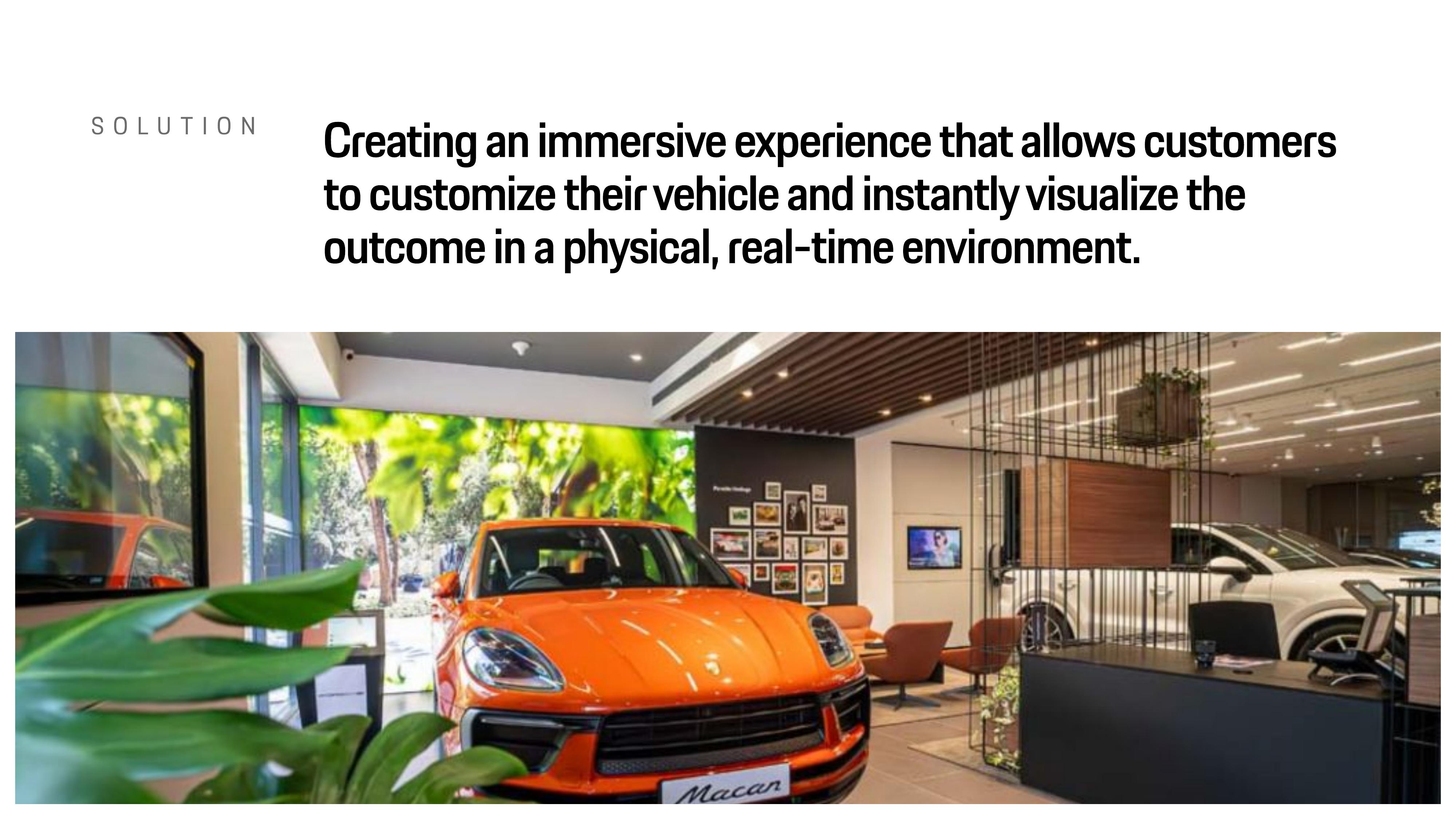
The problem space — showroom redirects to digital, losing physical presence
180+ colour options — cognitive overload without visual feedback
02 — The Solution
An immersive, physical-first configurator in the room with you.
A white 1:18 scale Porsche GT3 model becomes a live canvas. A projector maps real-time colour, wheel, and calliper configurations directly onto the physical surface. An Xbox Kinect mounted overhead captures hand gestures — left hand to change body colour, right hand to switch categories, both hands raised to cycle rims and callipers.
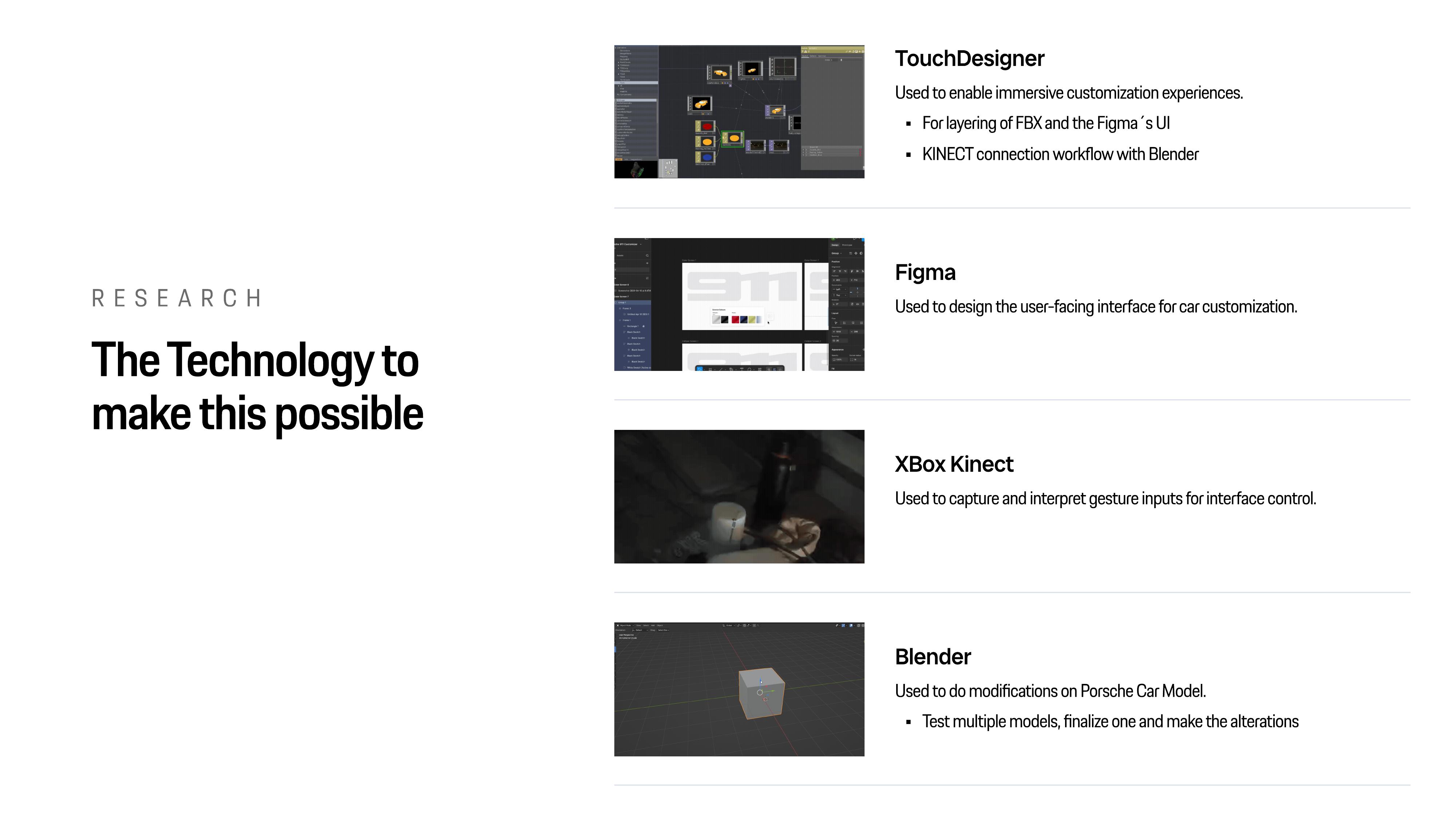
The entire experience is orchestrated in TouchDesigner — layering the FBX car model, the Figma-designed UI panels, and the Kinect gesture data into one real-time pipeline. You're not clicking a website. You're standing over your car and shaping it with your hands.
The solution space — immersive physical showroom
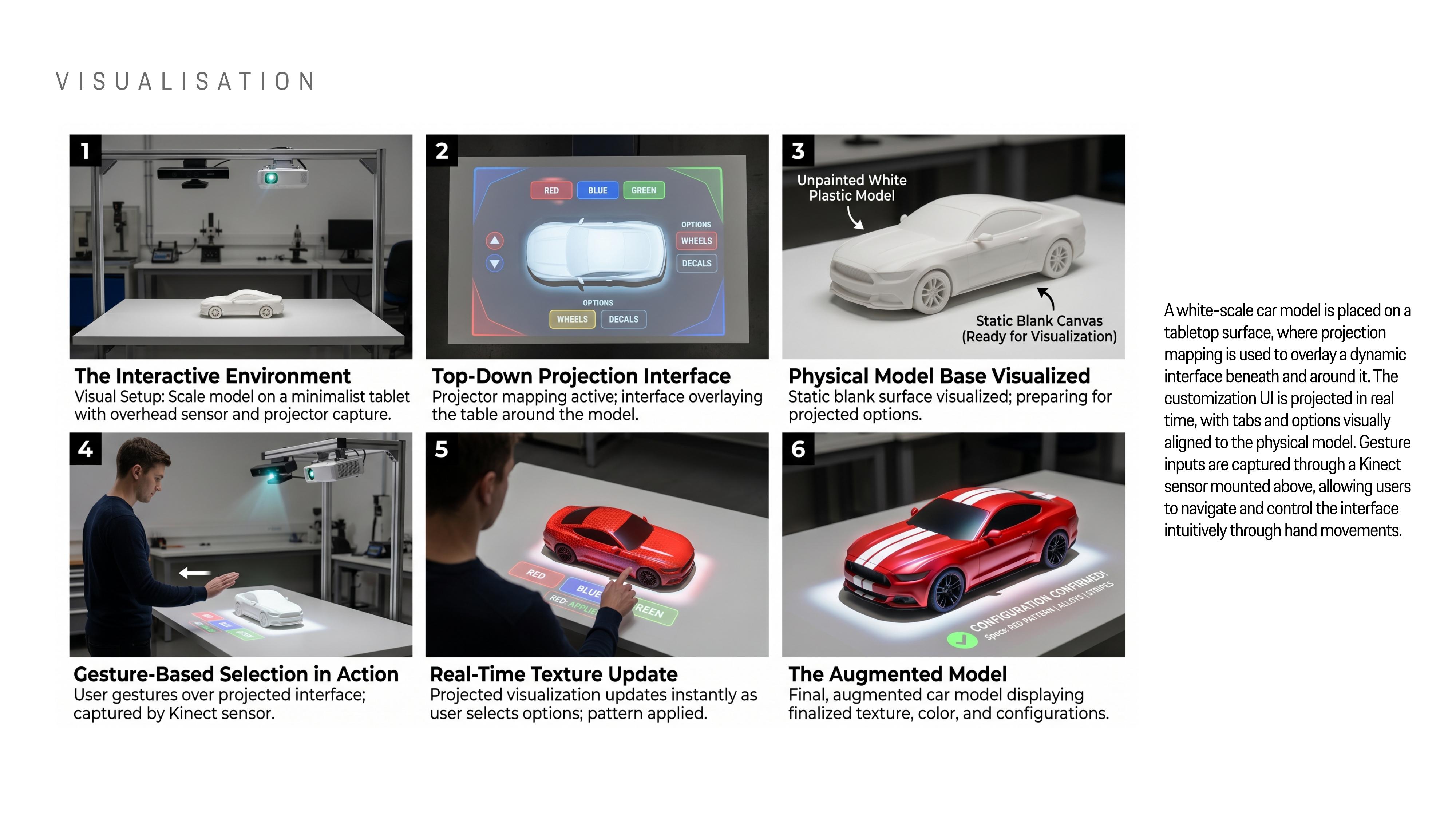
Six-stage pipeline — blank surface to augmented model
03 — Research & Inspiration
From car launches to racing games.
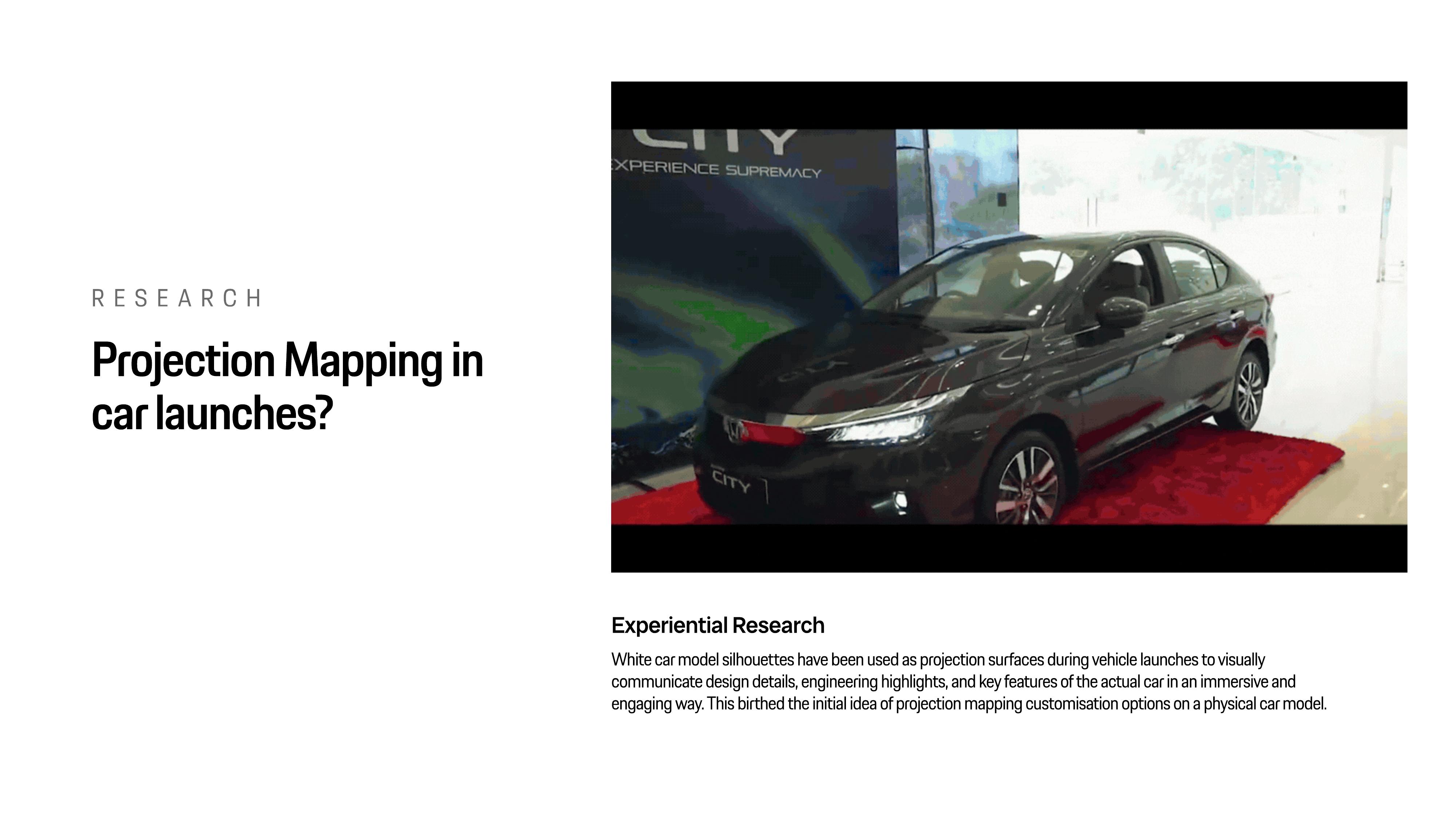
The initial insight came from experiential research into automotive launches — where white car silhouettes are already used as projection surfaces to communicate design detail and engineering highlights. The idea was there. The question was how to make it interactive.
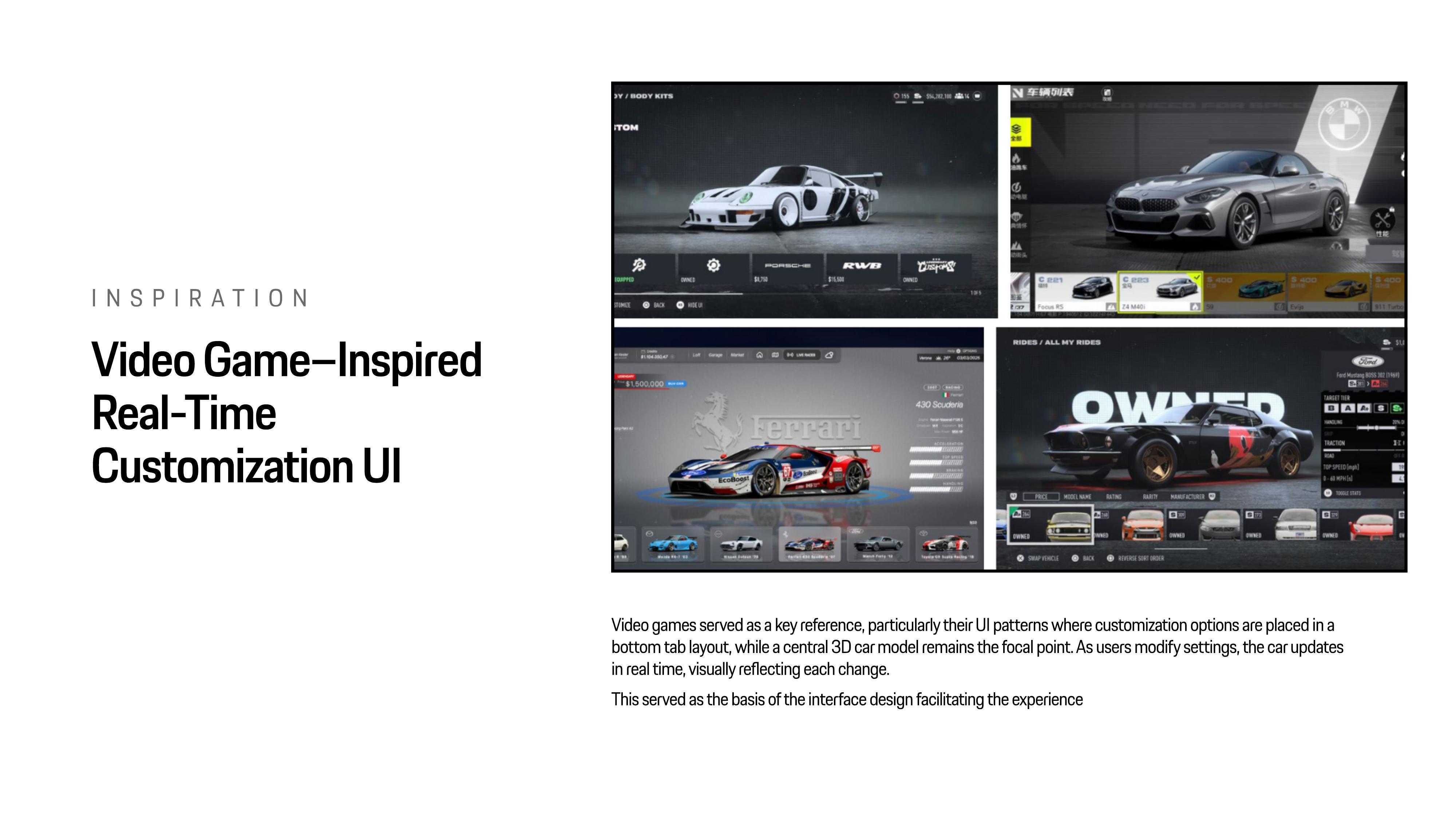
The UI interaction model came from an unexpected source: racing games. Gran Turismo, Forza, Need for Speed — they've solved the problem of real-time car customization with a bottom-tab layout, a central 3D focal point, and instant visual feedback. That pattern, transplanted into physical space, became the interaction foundation.
Video game UI patterns — the interaction model reference
Experiential Research
Studied automotive launch events where projection mapping onto white car models is already an established medium. This confirmed physical surfaces as valid projection canvases and gave precedent for the approach.
Racing Game UI Patterns
Video game customization UIs — particularly their bottom-tab layouts and real-time model updates — served as the direct interaction model. Games have already solved the cognitive load problem; we borrowed the pattern.
Technology Stack
TouchDesignerBlenderXbox KinectFigmaPython (body tracking)FBX 3D ModelProjection MappingReal-Time Rendering
04 — The System
Six stages from blank surface to augmented model.
The experience has a clear physical and technical architecture. A white-scale car model sits on a tabletop. The projector maps the UI beneath and around it. Kinect captures gestures overhead. TouchDesigner orchestrates the full pipeline — blending 3D geometry, UI panels, and gesture events into a single, coherent real-time output.
01 — Environment
Scale model on minimalist table. Projector + Kinect mounted overhead.
02 — Projection
Interface overlaid around the physical model via top-down projection.
03 — Blank Canvas
Unpainted white model acts as a static projection surface ready for visualization.
04 — Gesture Input
Kinect captures hand position. Python tracks tagged body parts in real time.
05 — Live Update
Color, wheel, and calliper changes apply instantly as projections update.
06 — Final Config
Augmented model displays the finalized spec — colour, alloys, callipers confirmed.
TouchDesigner was the central nervous system — layering the FBX Porsche model from Blender, receiving gesture data from the Kinect via Python, and compositing the Figma-designed UI panels into the final projection output.
05 — The Interaction
Your hands are the interface.
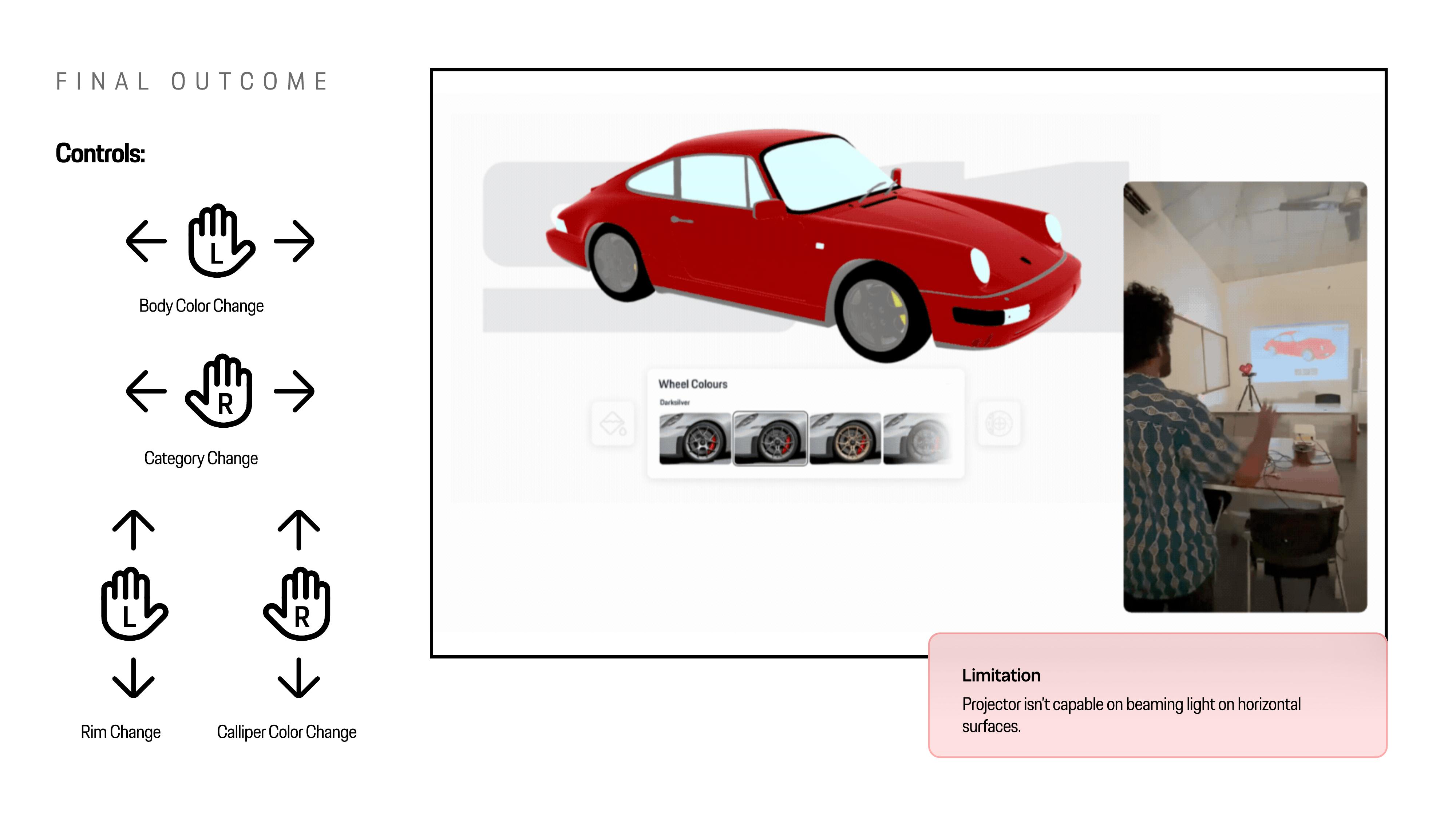
The gesture vocabulary was designed to be intuitive and low-fatigue. Four distinct hand gestures map to four distinct customization categories — body colour, rim type, calliper colour, and category navigation. The split between left and right hand creates a natural spatial division that mirrors how humans reach and select.
🤚
Left Hand ← →
Swipe left/right to cycle through body colour options
✋
Right Hand ← →
Swipe left/right to change active configuration category
👈
Left Hand ↑ ↓
Raise or lower left hand to scroll through rim designs
👉
Right Hand ↑ ↓
Raise or lower right hand to scroll calliper colour options
Why Swipe, Not Fingers
The original gesture concept leaned on finger-level detail — pinch to select, spread to compare. The Kinect's hand-tracking couldn't resolve that granularity; finger movements were misread as a second hand entering frame, breaking the input. The vocabulary was rebuilt around gross hand position and motion — swipes and raises — which the sensor could track reliably. A hardware ceiling turned into a simpler, more legible gesture set.
The Honest Limitations
The projector could not beam light onto horizontal surfaces effectively — a fundamental hardware constraint that meant the projection landed on the wall surface behind the model rather than the tabletop itself. This shaped the final visual language: the UI panels projected on the vertical surface adjacent to the model, with the car remaining the tactile anchor of the experience. A constraint that became a compositional decision.
Early testers experienced a moment of confusion — the left/right hand split wasn't immediately obvious, and a few misread which hand controlled what. After a brief verbal walkthrough of the mapping, users recovered quickly and the gesture logic clicked. This confirmed the split was learnable but not self-evident — a tradeoff accepted for a system built for short, guided showroom interactions rather than blind first-use.
Final outcome — gesture controls mapped to configuration categories
The configurator demonstrated a fully functional real-time gesture-interaction pipeline — Kinect input flowing through Python into TouchDesigner, updating projected colour and configuration options on a physical Porsche scale model. The system proved the concept: luxury car customization belongs in a room, not on a screen.
4
Gesture controls, rebuilt from finger-level to hand-level tracking
2
Gesture systems tested — finger-precision, then hand-position
4
Tools in the pipeline — TD, Blender, Kinect, Figma
Seconds
Time for testers to recover from initial gesture confusion
What This Proved
Physical artifacts can be living interfaces. The separation between "digital product" and "physical object" is a design failure, not a technical constraint. TouchDesigner is genuinely capable of holding a multi-source real-time pipeline — gesture data, 3D geometry, and UI compositing — in one coherent graph. And luxury experiences are defined by presence, not by polish.
07 — My Role
Interaction design, system architecture, UI build.
Interaction Design
Defined the gesture vocabulary and interaction model. Mapped the four gesture states to the four configuration categories, designing for spatial intuition and low cognitive load. Referenced racing game UI patterns as the conceptual foundation.
TouchDesigner Pipeline
Built and maintained the core TD network — layering the FBX car model, Kinect gesture input, and Figma UI panels into a single real-time output. Handled the KINECT → Blender → TouchDesigner connection workflow.
UI & Visual Design (with Spandan Sarkar)
Collaborated on the configurator interface — panel layout, colour swatches, wheel selector, and calliper picker — designed by Spandan in Figma. Integrated the UI as a composited projection layer within TouchDesigner, which shaped scale, contrast, and placement decisions for legibility on a projected surface.
Research & Framing
Led the experiential research into automotive projection mapping and gaming UI patterns. Translated findings into a coherent design brief that grounded every technical decision in a clear user need: restore the emotional weight of buying a Porsche.
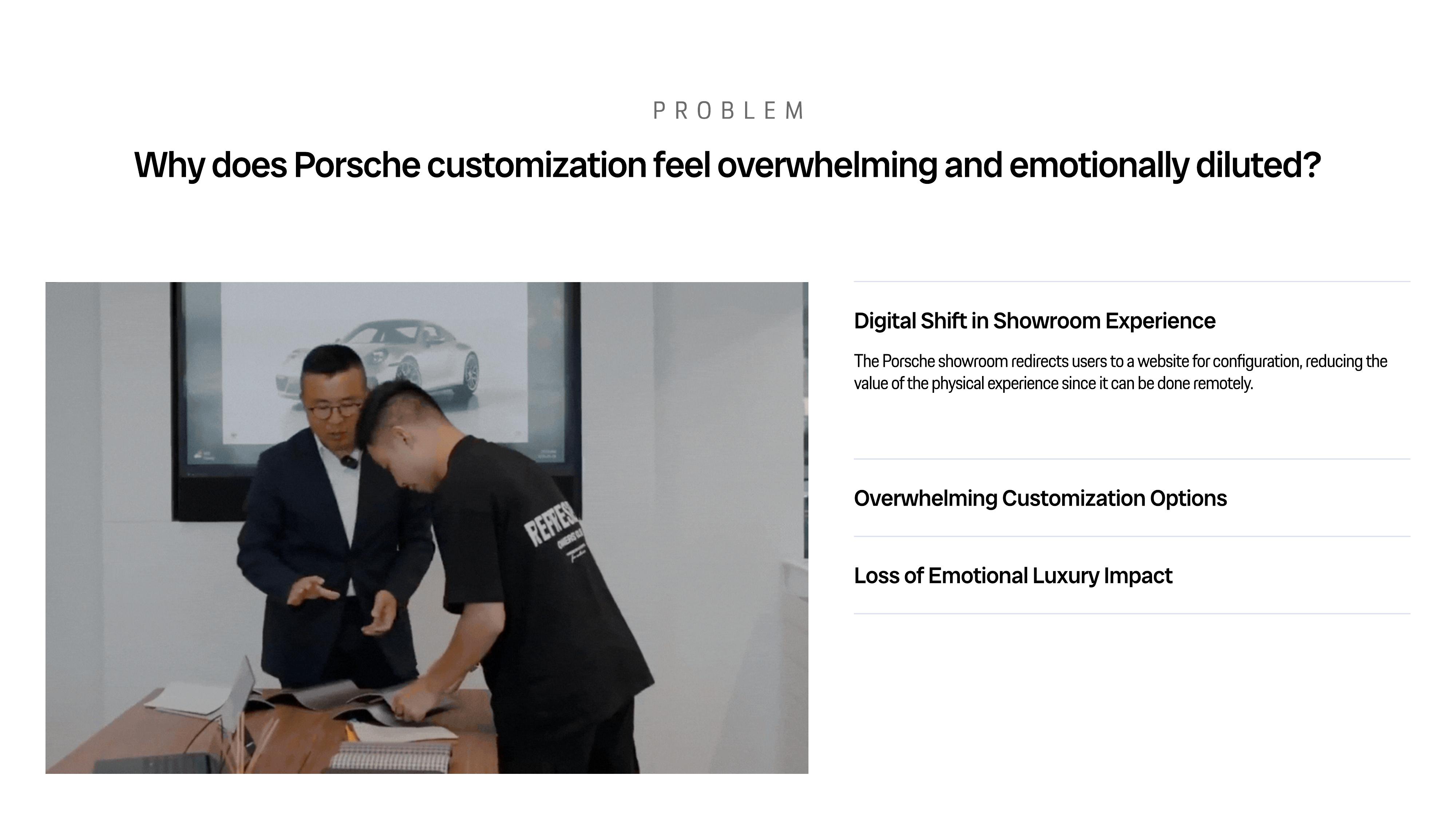 The problem space — showroom redirects to digital, losing physical presence
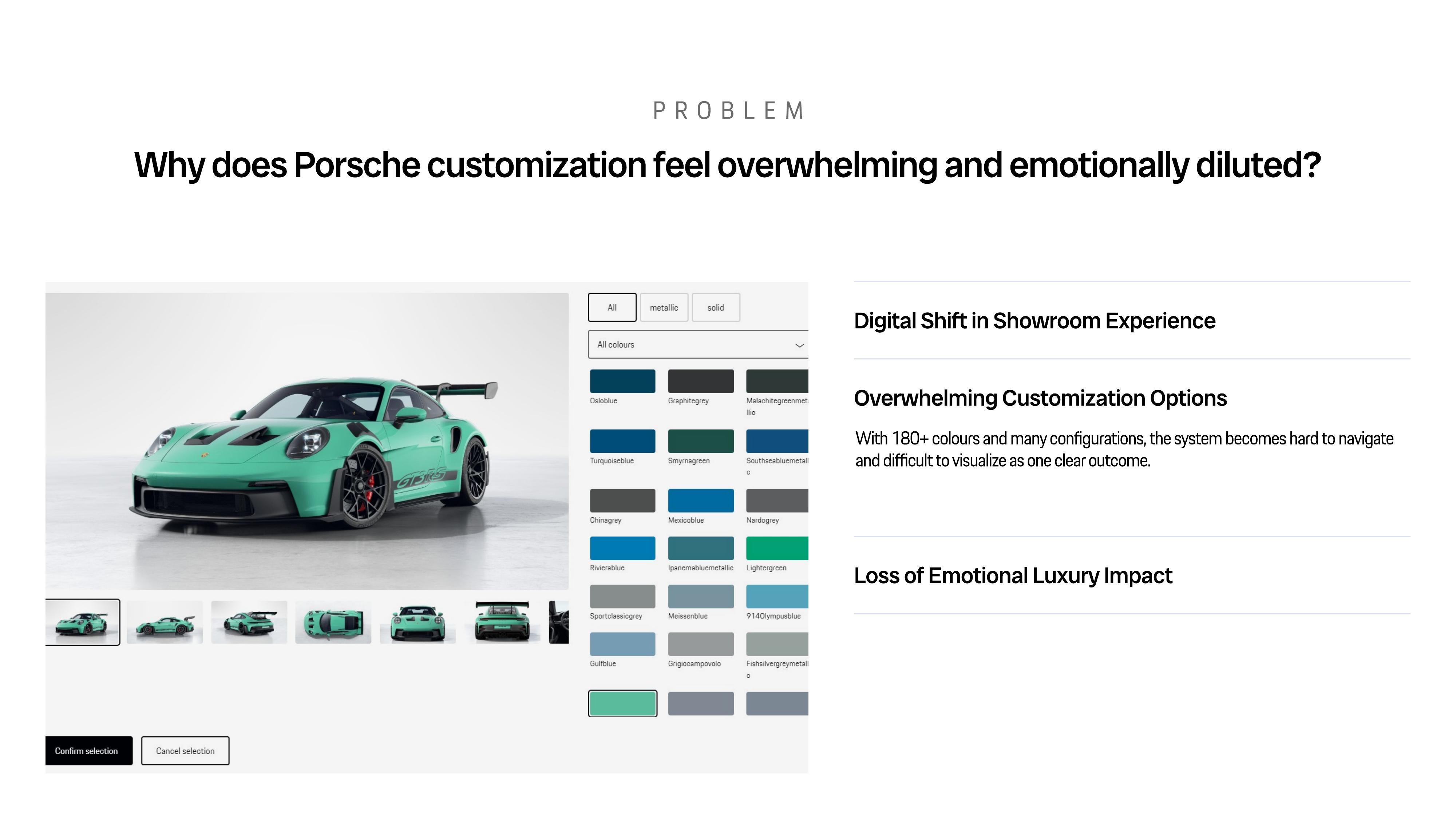 180+ colour options — cognitive overload without visual feedback