India's construction industry kills approximately 38 workers daily — and the helmet they're given hasn't
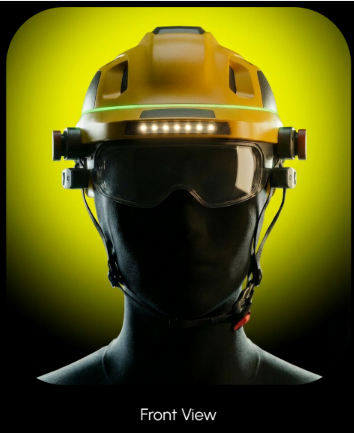
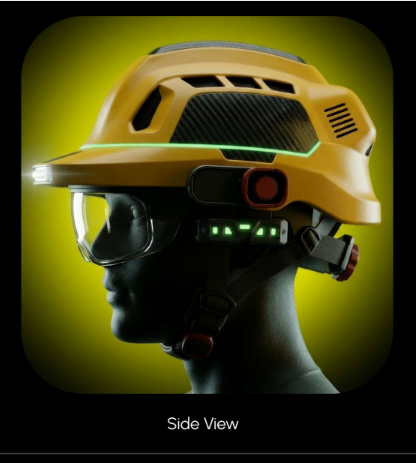
meaningfully evolved since the 1980s. We redesigned the construction helmet as a smart,
worker-centric safety system that senses, decides, and acts without burdening the worker.
Timeline2 Weeks — Rapid Sprint
Team5 Members
My RoleLead — Research, Hardware, Concept, Pitch
ContextAcademic Project
OutcomeWell Received by Faculty
01 — The Problem
Helmets protect from impact. They ignore everything else.
Traditional construction helmets focus exclusively on impact protection — absorbing blows from falling
objects. But the actual reasons workers die or get injured on Indian construction sites are far broader:
heat exhaustion, proximity to hazard zones, improper wear, and zero real-time feedback. The
helmet hasn't meaningfully changed since BIS introduced IS 2925 in 1984.
Worse — workers actively remove their helmets because they're uncomfortable. Heat-trapping
shells, poor ventilation, one-size-fits-all fit, and neck strain from 8–10 hour shifts make abandonment a
rational response, not negligence.
38
Workers die daily on Indian construction sites
24.2%
Of all occupational fatalities are in construction
11,614
Estimated annual construction fatalities in India
88.8%
Of victims are males aged 21–40, mostly migrant
The Core Contradiction
Safety equipment that is too uncomfortable to wear consistently is not safe equipment —
it's a compliance checkbox. Workers treat helmets as fine-avoidance gear, not protection. The system
fails not because of the helmet's impact rating, but because its design ignores the 8 hours between
impacts.
02 — Research
Field visits. Worker interviews. Real site conditions.
We conducted primary research at active construction sites — observing workers in real conditions,
interviewing them about their relationship with helmets, and mapping the gap between compliance expectations
and actual behavior.
01
Field Observations
Watched how workers wear (and remove) helmets across shifts. Documented loosened straps, tilted
positioning, complete removal during breaks, and the moment-to-moment decisions that lead to
non-compliance.
02
Worker Interviews
Spoke directly with construction laborers about pain points — heat, weight, fit, sweat, neck
strain. Discovered that workers see helmets as productivity inhibitors, not protection. The
mental model is "avoid fines" not "stay safe."
03
Accident Data Compilation
Analyzed construction fatality data — falls from heights (33–59% of deaths), struck by objects
(10–21%), electrocution (6.6–8.6%), structural collapses (~10%). Mapped primary causes to helmet
design failures.
04
Standards & Regulatory Audit
Deep-dive into BIS IS 2925, ISI certification requirements, material standards (HDPE, ABS, PVC),
and the gap between regulatory mandates and on-ground enforcement reality.
03 — Key Insights
11 insights that redefined what a helmet should be
Our research surfaced a constellation of insights that all point to the same conclusion: the helmet
is not a product problem — it's a systems problem. Each insight maps to a specific design
implication.
Comfort ≠ Add-on
Comfort & Safety Trade-off
Workers remove helmets because existing designs prioritize compliance over long-duration comfort.
Comfort is a prerequisite for safety adoption, not an add-on feature.
Thermal = Critical
Heat & Fatigue
Thermal discomfort accumulates faster than perceived safety benefits. Helmet abandonment in heat is a
rational response, not negligence. Reducing thermal load directly improves compliance.
False Safety
Improper Usage
A helmet worn incorrectly creates a false sense of safety for both workers and supervisors. Correct
usage must be enabled passively, not enforced manually.
Silent Intelligence
Cognitive Overload
Workers operate in cognitively demanding environments. Adding complex "smart" interactions increases
mental load. Intelligence should work silently in the background.
Trust ≠ Surveillance
Trust & Privacy
When safety tools resemble surveillance systems, trust collapses and adoption resistance increases.
Worker dignity must be preserved.
Ecosystem Thinking
System Fragmentation
Helmets, sensors, supervisors, and safety protocols function as disconnected entities. Safety must be
approached as an ecosystem, not a standalone product.
04 — The System
Sense. Decide. Act. Fail-safe.
Kavach operates on a six-stage smart loop that runs entirely on the helmet — no phone dependency, no
cloud requirement, no internet needed. The system works with minimal training for workers with
low digital literacy.
Sense
Helmet presence, proximity to hazard, sudden impact
Decide
Is helmet worn? In danger zone? Critical event?
Act
Vibrate helmet, flash LED, trigger local alert
Confirm
Worker corrects behavior, exits danger zone
Log
Event logged locally, supervisor notified if critical
Fail-safe
Works offline, defaults to physical alerts
The Design Constraint
The BIS-certified helmet shell remains unchanged. We're not redesigning the helmet —
we're adding a smart layer on top of it. The system must work with existing IS 2925 compliant shells,
require no structural modification, and add negligible weight. Fixed assumptions: no internet,
low digital literacy, minimal training, zero phone dependency.
Features
01
Helmet-Wearing Detection
Detects whether the helmet is properly worn. If removed or tilted, haptic vibration + LED alert
triggers. No manual check needed — passive compliance enforcement.
02
Haptic & LED Alerts
Multi-modal alerts (vibration + visual LED) for hazard proximity, improper wear, and zone
breaches. Designed to work in noisy environments where audio alerts fail.
03
Zone / Proximity Awareness
Detects when a worker enters a designated hazard zone. Triggers escalating alerts based on
proximity — gentle vibration at perimeter, intense at threshold.
04
SOS Button + Ventilation
One-press SOS for emergencies. Temperature-responsive ventilation adjusts airflow based on
thermal conditions. Modular accessory racks for site-specific add-ons.
05
Offline Site Safety Mesh
Helmet-to-helmet mesh network operates without WiFi or cellular. Supervisor-level notifications
propagate through the mesh. Events logged locally and synced when connectivity returns.
We built a working prototype with sensors mounted on a BIS-certified helmet shell. The electronics integrate
without structural modification — the smart layer clips onto the existing suspension system and adds minimal
weight.
Led primary research at construction sites — observations, worker interviews, and behavioral mapping.
Compiled and analyzed accident data from NCRB and industry reports. Synthesized 11 key insights that
drove every design decision.
Hardware & IoT
Designed the sensor architecture, selected components (ESP32, IMU, temp/proximity sensors, haptic
motors), built the working prototype, and programmed the Sense → Decide → Act → Fail-safe loop in
Arduino IDE.
Concept & Industrial Design
Led concept exploration and selection — evaluated multiple form factors against feasibility, user
comfort, and BIS compliance. Defined the modular add-on system, ventilation approach, and SOS
interaction.
Team Lead & Pitch
Spearheaded a team of 5, set direction, managed scope within the 2-week sprint, and delivered the
final presentation to faculty — connecting every feature back to a specific research insight.
07 — Outcome
Presented. Validated. A system, not a gadget.
Kavach was presented to faculty and well received — recognized for its depth of field
research, the insight-to-design traceability, and the working prototype that demonstrated the smart loop in
real hardware. The project proved that construction safety isn't a helmet problem — it's an
ecosystem problem requiring worker-centric systems thinking.
2wk
From field research to working prototype
11
Research insights → design implications
6
Stage smart loop — sense to fail-safe
5
Team members led through the sprint
Next Steps
The project continues with three priorities: refining the form factor for construction compliance, adding
more passive-dependent technology to avoid connectivity issues, and aligning the system closer to
workers' existing mental models — making it invisible enough that they forget it's there.