India's coworking industry is fragmented — one app for booking, another for mail, zero compliance
integration. We designed a unified SaaS ecosystem that bridges physical coworking and
digital compliance into a single platform.
Timeline8–10 Weeks
Team3 Members
My RoleLead — UX Strategy, Service Design, IA
ContextAcademic Semester Project
OutcomeSelected for Further Development
01 — The Problem
Fragmented workflows. Zero trust.
Virtual office and coworking providers in India fragment essential services — virtual addresses, workspace
booking, government compliance, and communication — into separate products with separate billing. The
result: operational friction, hidden costs, and a persistent trust gap where users fear
their virtual office isn't fully legitimate.
Trust Gap
Fear that virtual offices aren't fully legitimate or compliant for GST registrations. Users can't
verify if their address will hold up under regulatory scrutiny.
Fragmentation
Current providers split virtual address, coworking booking, compliance, and communication into
separate services — each with its own billing, login, and support channel.
Transparency Issues
Hidden costs in service add-ons, unclear invoices lacking service breakdowns, documentation
delays leading to uninformed decision-making.
Operational Friction
Long onboarding, manual verification, lack of real-time updates, and difficulty resolving
compliance/documentation queries quickly.
4
Major pain points identified from primary + secondary research
3
Competitors benchmarked — Regus, WeWork, Awfis
3
Distinct user personas across freelancers, startups, SMEs
02 — Research
Primary interviews. Competitive teardowns. Work models.
We ran a mixed-methods research approach — primary interviews and observations of coworking
hub users and managers, combined with secondary benchmarking of Regus, WeWork, and Awfis. The data was
synthesized through affinity mapping, work models, and a full competitive landscape analysis.
01
Empirical Research & Interviews
Conducted user interviews with freelancers, startup founders, and SME managers. Mapped benefits
availed vs. pain points emerged. Behind-the-scenes observations at active coworking spaces.
02
Work Models
Built five work models from field data — Culture Model, Flow Model, Sequence Model, Artifacts
Model, and Physical Model — to understand how people actually use workspace services vs. how
providers assume they do.
03
Competitive Teardown: Regus
Full service teardown of Regus — strategy context, acquisition channels, audience segmentation,
cognitive biases in their communication, friction points, and maturity stage analysis. This
became the benchmark for what Arbeiten needed to surpass.
04
Market Sizing & ICP
Defined market size assumptions for metro/tier-1 Indian cities, built competitive landscape maps,
and created Ideal Client Profiles for each user tier.
03 — User Personas
Three tiers of users. One scalable platform.
Arbeiten scales from solo freelancers to enterprise SME teams within the same ecosystem. Each persona has
distinct complexity needs, usage frequency, and motivation — the platform adapts to serve all three without
compromise.
Tier 1
Freelancer
23–38 years · Simple (4–10 tasks)
Needs daily hot desks for professional work and client meetings + a virtual address for mail
handling. Seeks credibility without overhead. Uses the platform daily or a few times a month.
Tier 2
Net-Entrepreneur
25–42 years · Moderate (11–30 tasks)
Needs desks/small cabins for collaboration + virtual office for professional branding and GST
registration. Hub for team communication and project collaboration. Reduces overhead costs.
Tier 3
SME Team
30–55 years · Complex (31+ tasks)
Needs dedicated coworking spaces for teams + managed virtual office solutions. Full amenities,
compliance tools, payroll integration, and scalable lease options.
04 — Service Design
We didn't design screens. We engineered a service.
Arbeiten's architecture maps the entire user journey — from KYC onboarding to physical desk allocation, mail
handling, compliance automation, and team collaboration. Every touchpoint was blueprinted before a single
pixel was placed.
The Core Design Decision
We prioritized power-user efficiency over day-one simplicity. The platform has a steep
initial learning curve because we refused to fragment features into separate apps. A freelancer's day
pass flow and an SME's managed office workflow live in the same architecture — the complexity is real,
but it's honest complexity. No hidden costs, no surprise add-ons, no switching between three different
dashboards.
01
Customer Journey Maps
End-to-end journey maps for each persona — from awareness through onboarding, daily use,
compliance cycles (GST filing, ROC deadlines), and eventual scaling or offboarding.
02
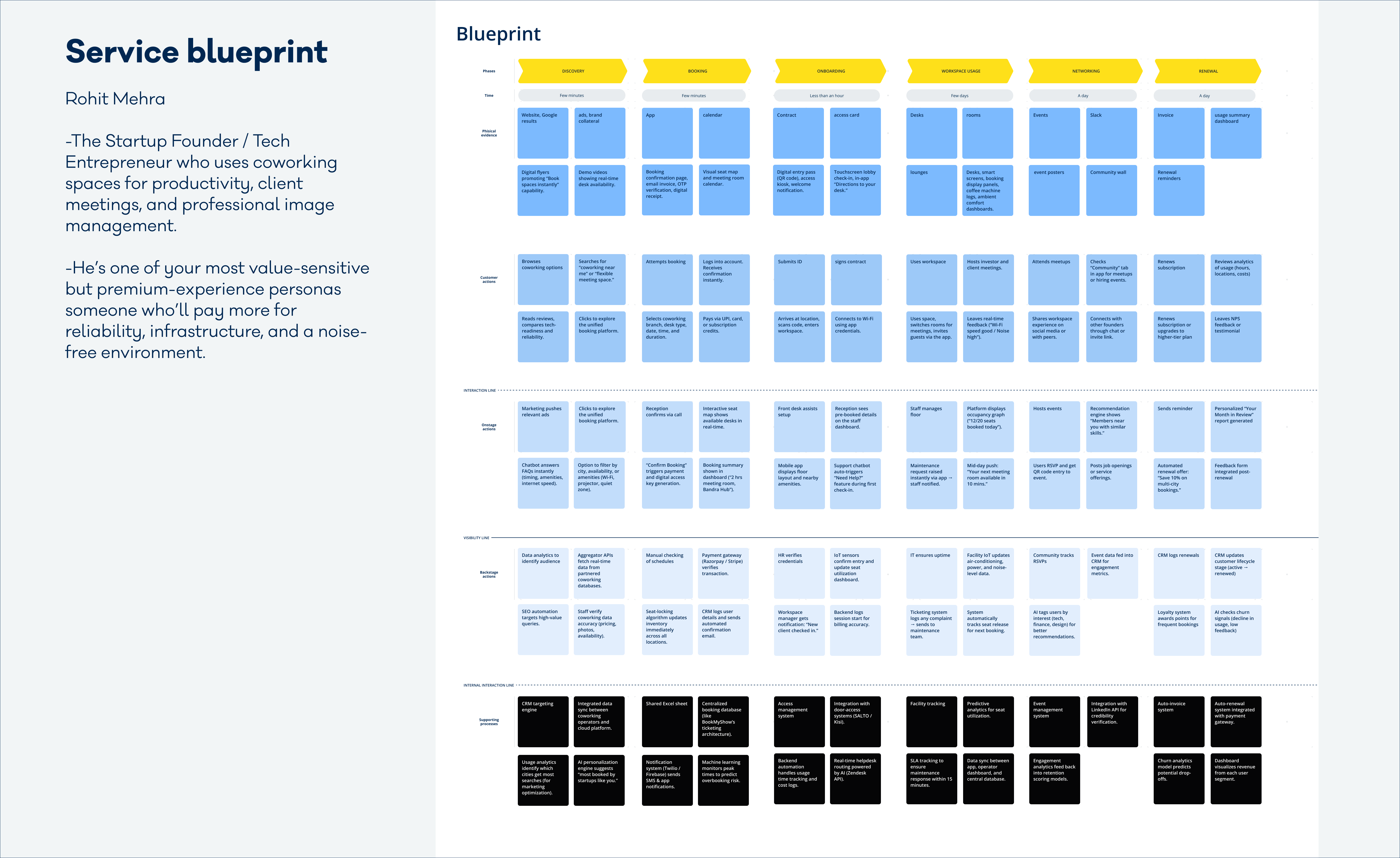
Service Blueprints
Full-stack service blueprints mapping frontstage actions, backstage processes, support systems,
and physical evidence for every major flow — booking, mail handling, compliance, payments.
03
Information Architecture
Structured the entire platform — virtual address management, workspace booking, collaboration
hub, operations/finance suite, and customer engagement tools — into a navigable hierarchy that
scales with user tier.
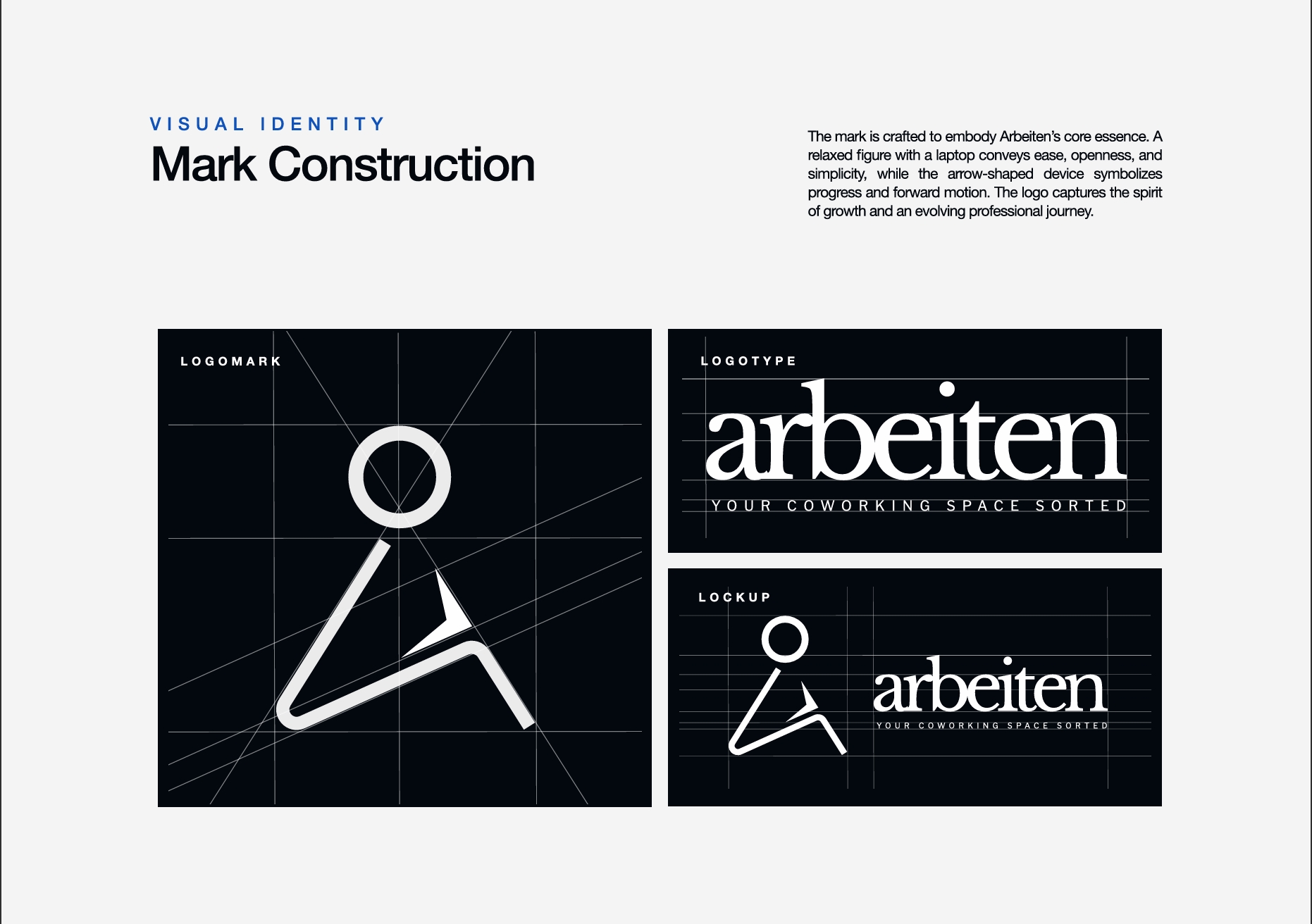
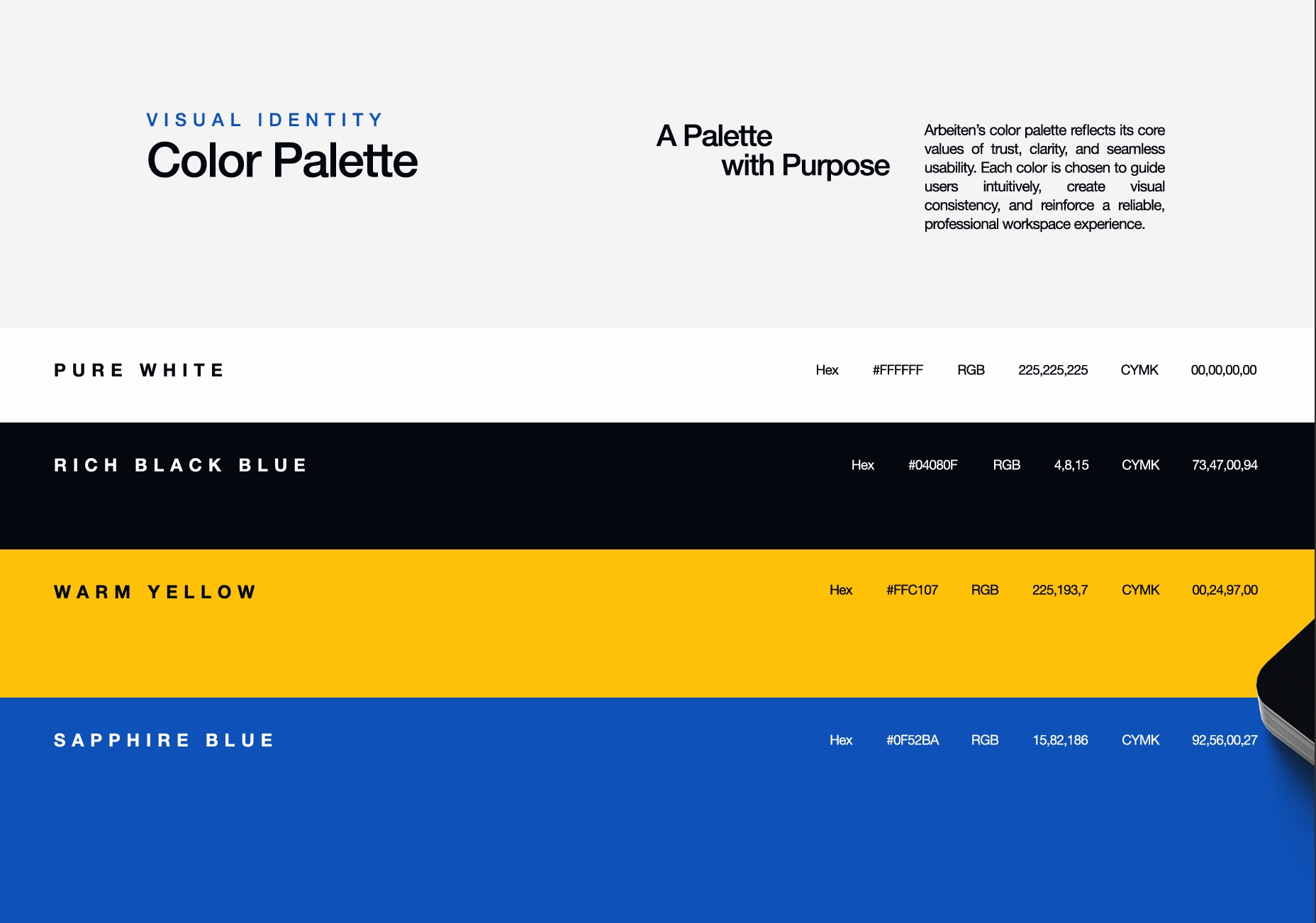
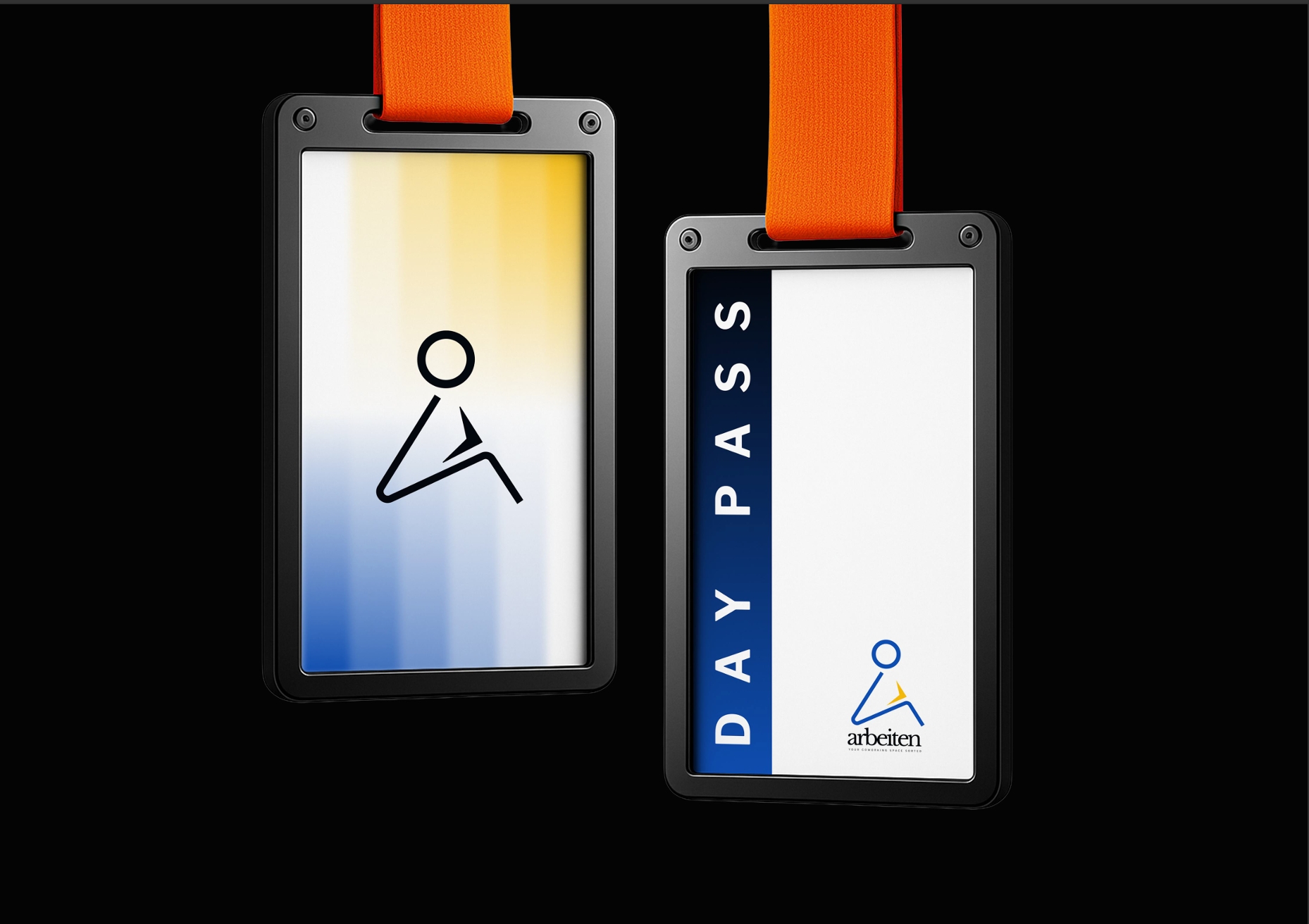
The name "Arbeiten" (German: "to work") signals precision and reliability. The visual identity was built on a
modular grid with two strategic color choices — Sapphire Blue for corporate stability and
Signal Yellow for operational efficiency.
Sapphire Blue
#0F52BA — Primary
Warm Yellow
#FFC107 — Secondary
Neutral Light
#F5F5F5 — Background
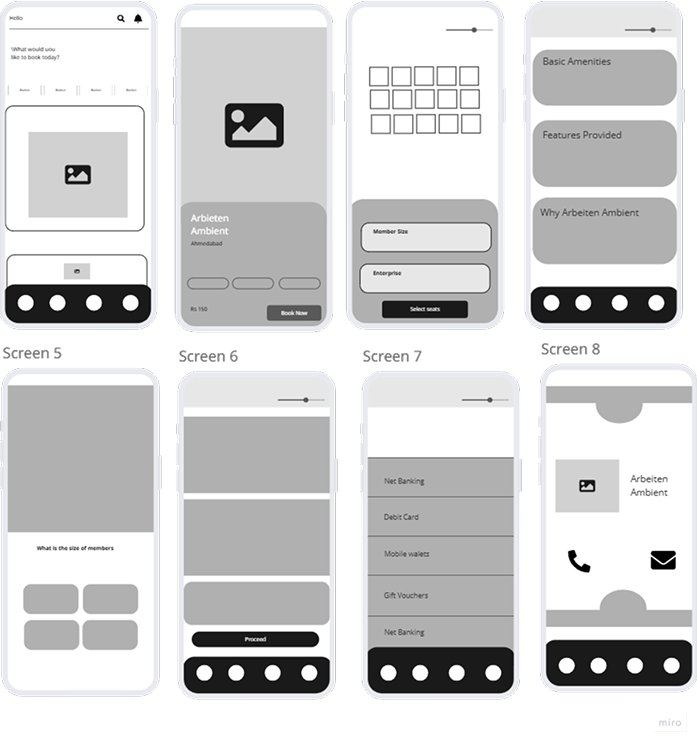
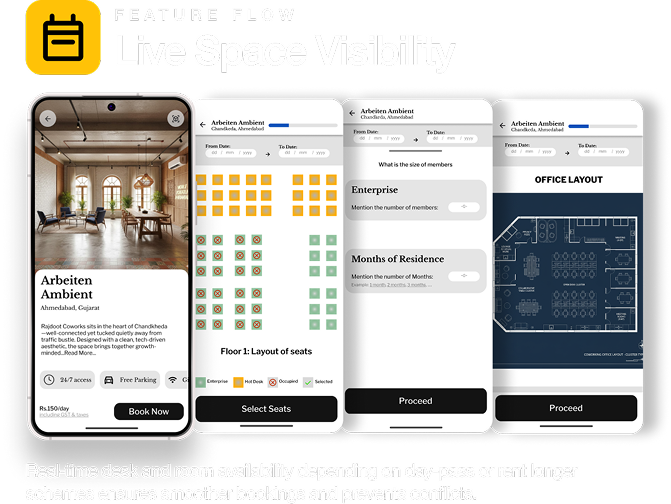
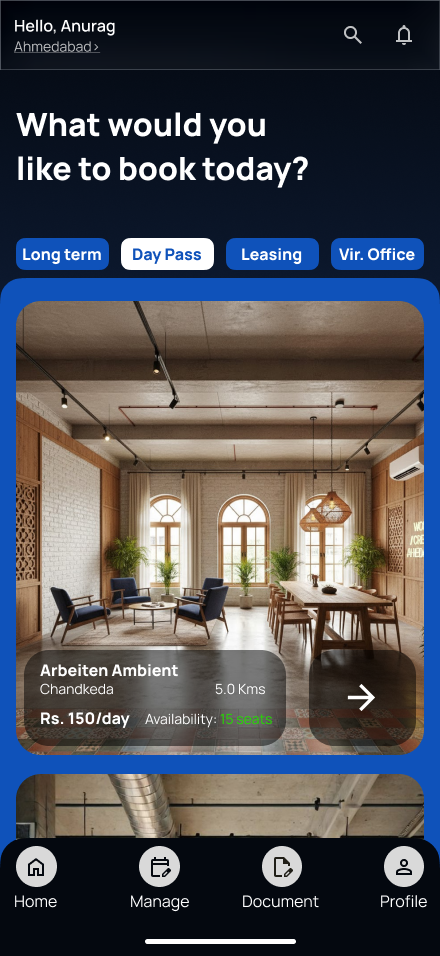
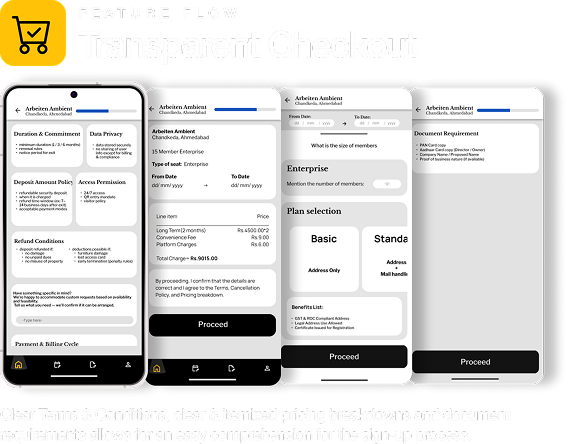
The UI evolved from low-fidelity structural wireframes to a polished Glassmorphic interface — chosen
deliberately to convey transparency (literal and metaphorical) in a market plagued by hidden costs and
unclear policies.
06 — My Role
Leading the service architecture from research to screens
UX Strategy & IA
Defined the product scope, feature phasing, information architecture, and user flows for all three
persona tiers. Structured the entire platform hierarchy so a freelancer's 4-task flow and an SME's
31+ task workflow coexist without friction.
Service Design
Built the customer journey maps and service blueprints — mapping frontstage, backstage, and support
processes for every major flow. This was the backbone that ensured the UI wasn't just screens, but a
fully thought-through service.
User Research & Analysis
Led primary research (interviews and observations at coworking hubs), synthesized findings into work
models and affinity maps, and ran the competitive teardown of Regus that became our strategic
benchmark.
Team Direction
Directed a team of 3 — Spandan Sarkar on Research & Strategy, Sanglap Chakraborty on Operations
Logic. I set the design direction, managed scope, and ensured every research insight connected to a
concrete design decision.
07 — Outcome
Selected for further development.
Arbeiten was selected for further development beyond the semester — recognized for its depth of service
design thinking, the quality of the competitive teardown, and the scalable platform architecture. The
project demonstrated that workspace SaaS in India isn't a UI problem — it's a trust and service
design problem that requires end-to-end ecosystem thinking.