In just 3 days, hundreds of children vanished into crowd density at Panchkula. Standard GPS was
blocked by the sheer mass of human bodies. We built an intelligent ecosystem to ensure this
never happens again.
Timeline48-Hour Hackathon
Team2 TRIADS — 7 Members
My RoleTeam Lead & Lead Researcher
EventCTRL+CREATE, UID
Outcome1st Place Winner
01 — The Problem
A child goes missing in India every eight minutes.
The issue of child safety in India's crowded public spaces is a systemic crisis. The constant movement of
large populations creates scenarios where children can be separated from guardians in moments. The data from
the National Crime Records Bureau (NCRB) is unambiguous.
177,335
Crimes against children in 2023 — a 9.2% rise
71.4%
Of missing children are girls — linked to trafficking
51,100
Minors listed as unrecovered victims of abduction
84,119
Children rescued by RPF from railway stations (2018–2024)
The current system is manual, discretionary, and reactive. Police routinely delay filing
FIRs despite a 2013 Supreme Court mandate. CCTV is passive. PA announcements are inaudible. Security guards
are stretched thin. Every step is a potential point of failure — a chain of manual handoffs where a panicked
parent's verbal report can be dismissed or downplayed.
The Core Insight
The fundamental flaw isn't the lack of technology — it's the absence of an automated, accountable
trigger. The existing process relies on human discretion at every step. A time-stamped,
GPS-located digital alert sent simultaneously to the parent, venue security, and a police portal cannot
be ignored. That's what we built.
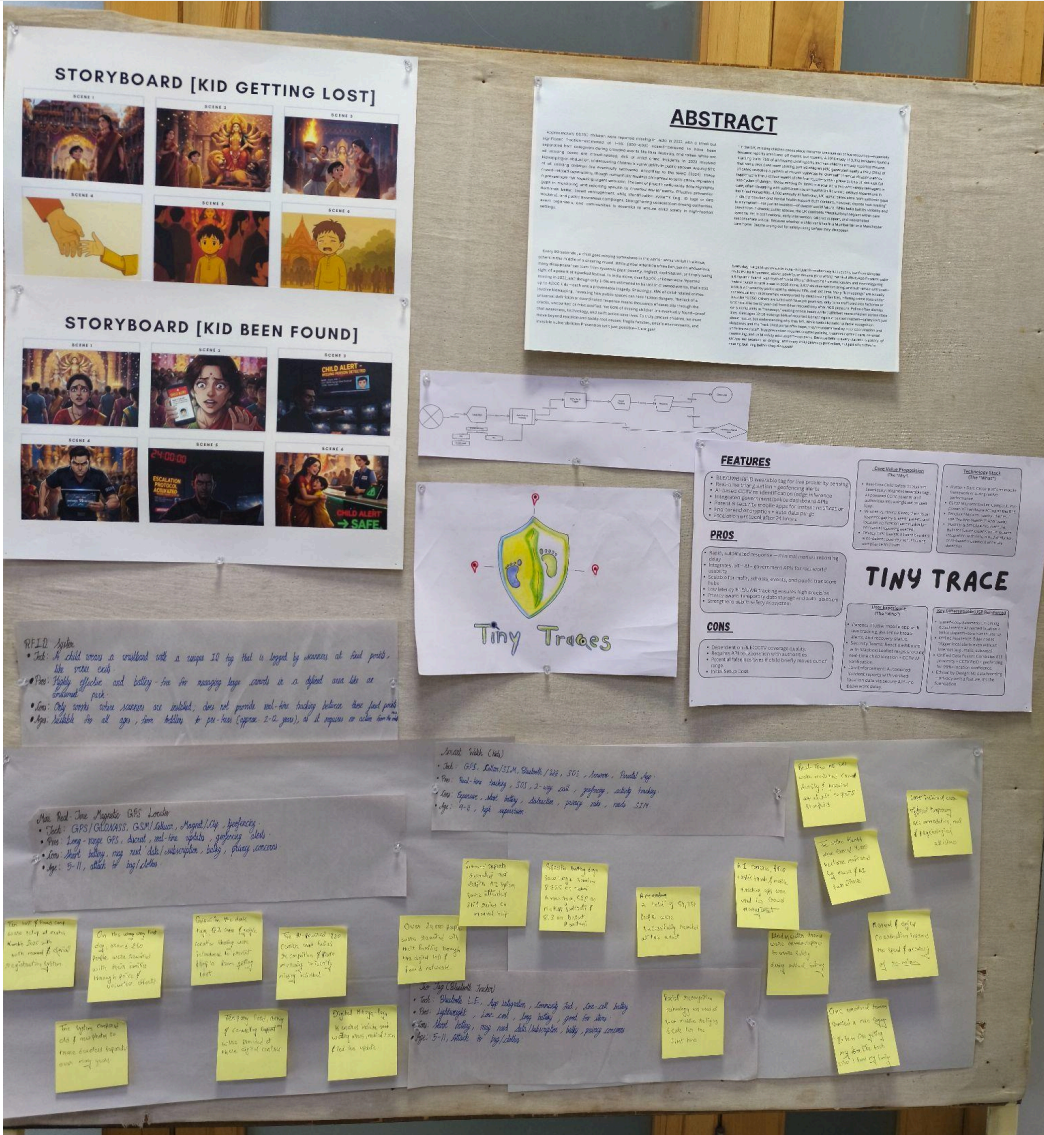
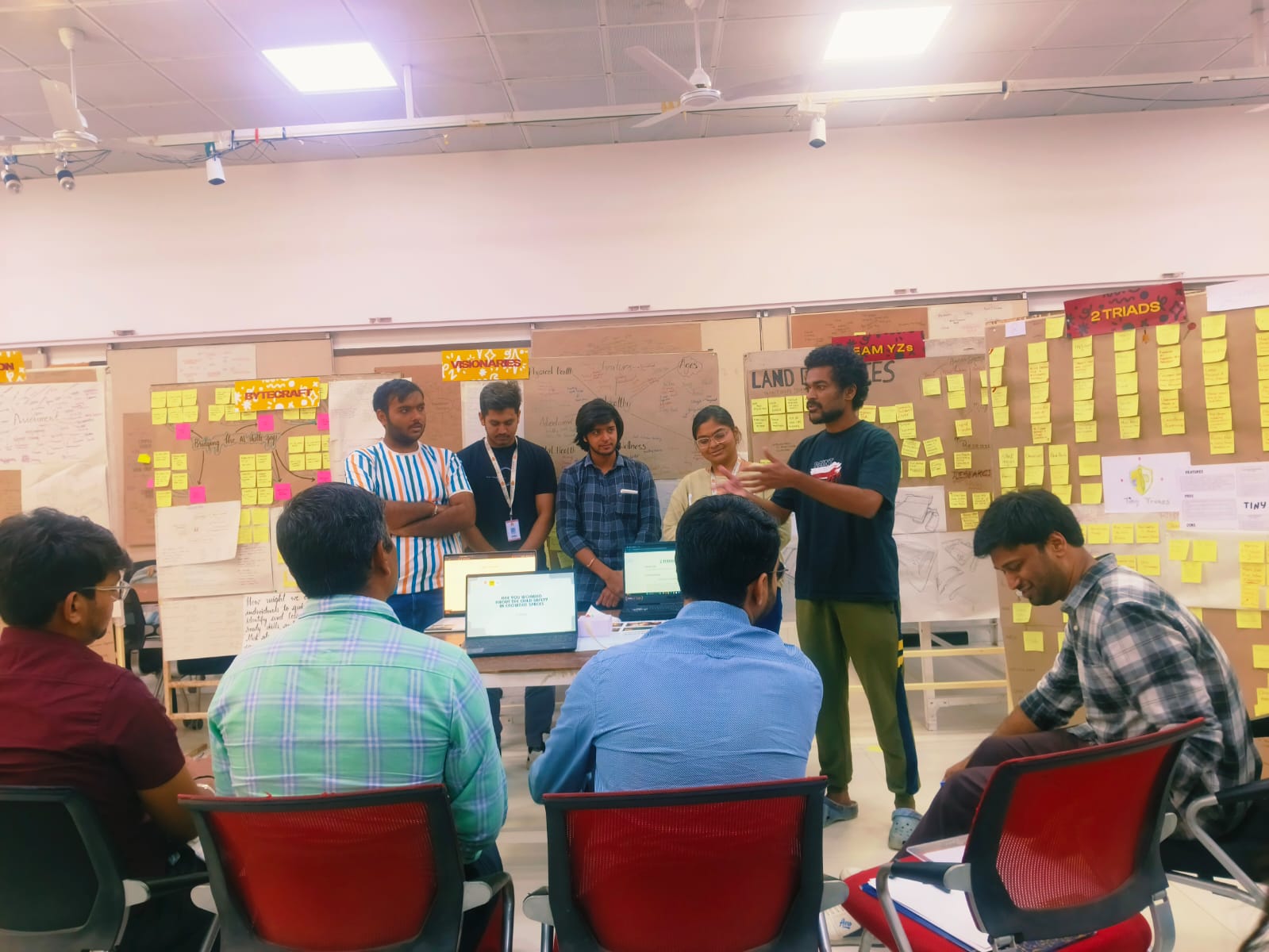
We mapped high-risk environments, analyzed cognitive behavior of lost children by age group, audited existing
solutions, and identified systemic failure points — all on chart paper, sticky notes, and whiteboards before
touching a screen.
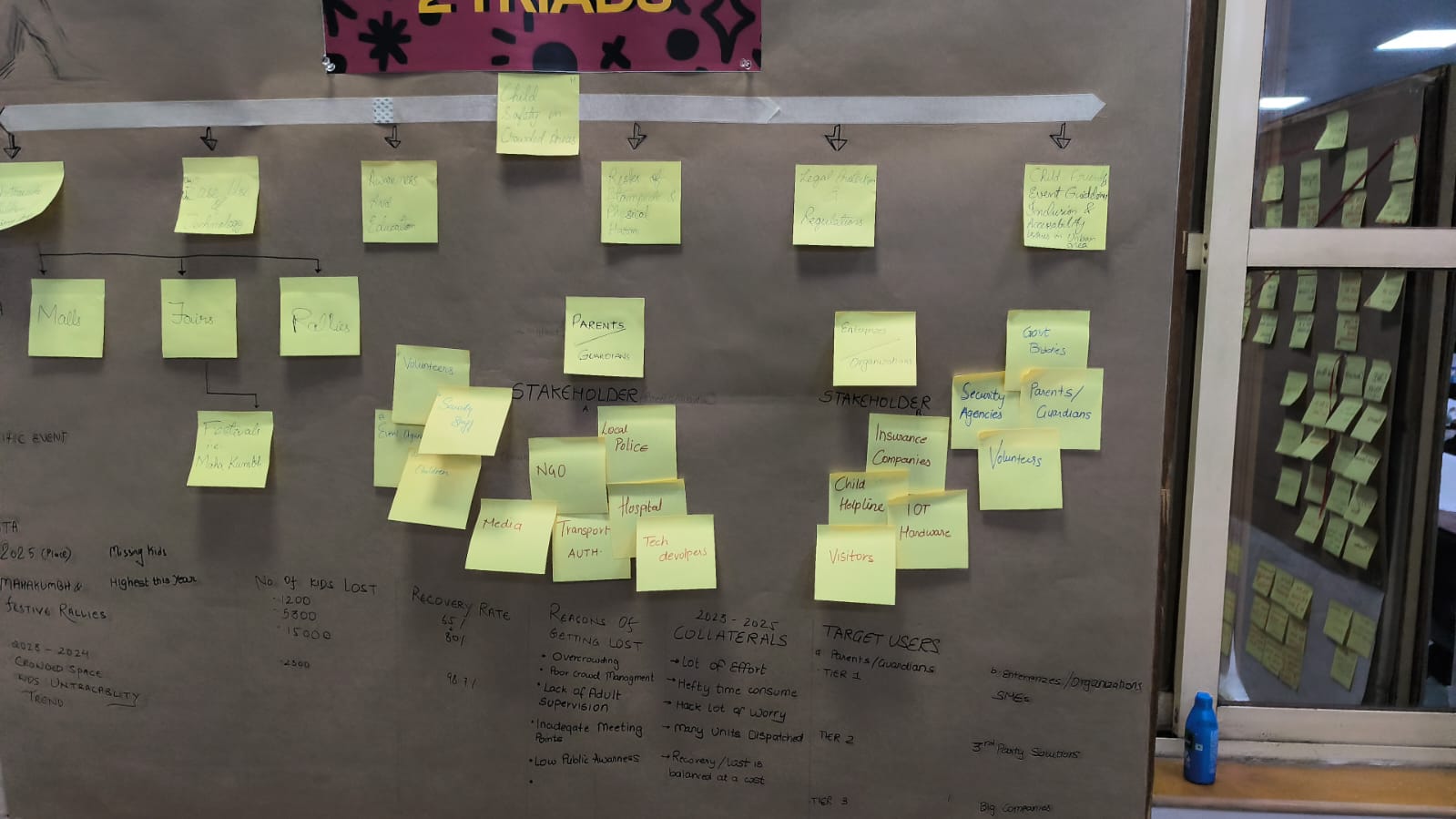
We identified three tiers of high-risk zones: transit hubs (railway/bus stations) where
children can be transported across state lines within hours, religious festivals (Kumbh Mela, Durga Puja)
with extreme crowd density, and urban commercial centers (malls, markets) with complex multi-floor layouts.
A critical finding was the cognitive behavior gap by age: children aged 2–4 freeze and cry,
5–7 year-olds wander confidently toward remembered landmarks, and 8–10 year-olds actively avoid asking
adults for help. Each behavior demanded a different system response.
My Contribution — Research Phase
I aligned the team to the child safety brief from the hackathon's problem list, set the research
direction, did the deep-dive into NCRB data and NCRB-adjacent sources (Google Scholar, government SOPs),
mapped stakeholders and pain points onto chart paper, and — crucially — taught the developers on
the team how to think like designers: empathy mapping, problem framing, second-order
effects. The entire wall of sticky notes, stakeholder maps, and data charts was built hands-on before
any code was written.
03 — The Solution
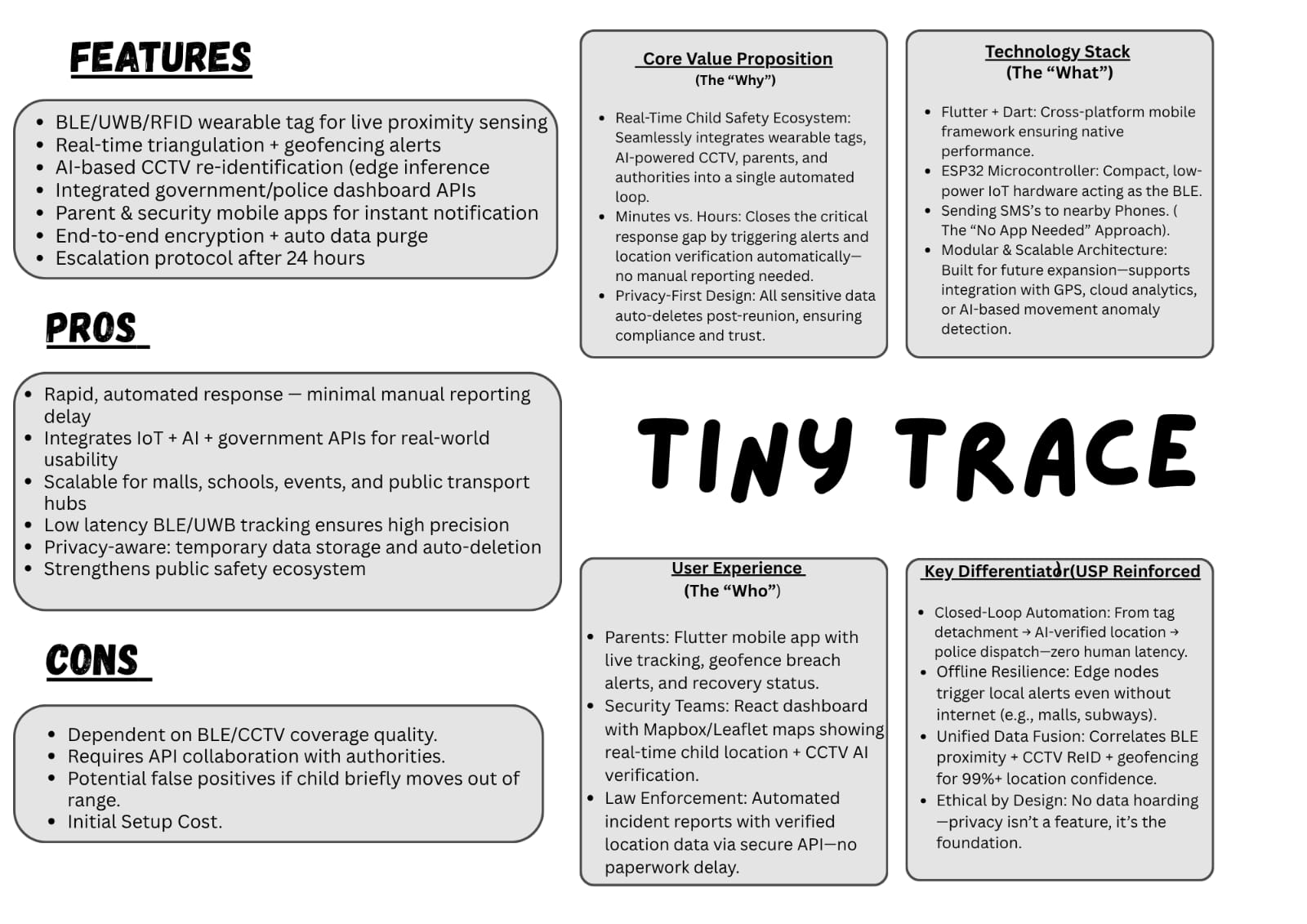
Tiny Traces — an intelligent 4-stage safety ecosystem
We designed a multi-tiered response system that escalates proportionally to risk — from a gentle proximity
ping to a full police automation pipeline. The principle: prevent the separation from becoming a
crisis.
01
Proximity Alert — Under 10 Seconds
A child's BLE wearable tag detects separation when signal strength drops below a safe threshold.
Instant vibration on both the parent's phone and the child's wearable. Most incidents resolve
here.
02
Active Tracking — Immediate
Parent activates "Active Search Mode" in the companion app. Real-time map shows child's location
using hybrid GPS/Wi-Fi/BLE triangulation. Empowers the parent to move directly toward the child.
03
Venue Alert — Under 2 Minutes
If the child isn't located, a single button dispatches an alert to the venue's security dashboard
with the child's photo, name, clothing, and last-known coordinates. CCTV re-identification via
YOLOv8 + DeepSORT runs on edge nodes to locate the child in live feeds.
04
Police Automation — Under 10 Minutes
System auto-forwards a time-stamped incident dossier to the local SJPU portal — bypassing the
manual FIR delay that currently wastes the critical "golden hours." All temporary data is purged
upon reunion per COPPA/GDPR-K.
04 — The Platform
Three interfaces, one unified safety ecosystem
Tiny Traces isn't just a wearable — it's a full-stack platform with a Flask backend, live
BLE/RSSI monitoring, a data analytics dashboard, and a CCTV re-identification system. Three views, three
user types, one coordinated response.
Interface 01 — Alerts Dashboard
The command center. Live BLE/RSSI signal monitoring polls every 3 seconds — green for safe, red for
out-of-range with a one-click "Notify Response Team" action. At-a-glance KPIs (total records, recovery
rate, still missing count) and top locations by state/city. This is the screen security personnel see in
real time.
Live RSSI PollingBLE Threshold AlertsOne-Click ResponseTop Location KPIs
Interface 02 — Insights Dashboard
The analytics layer. Built on a 10,000-record missing children dataset parsed from CSV into Pandas.
Monthly trend lines, recovery time histograms, age/height/weight distributions, categorical breakdowns
(gender, race, circumstance, reporter type), and geographic heatmaps — all rendered via
Chart.js doughnut and bar charts. This is the screen researchers and policy teams use.
10,000 Record DatasetChart.js VisualizationsPandas AnalyticsRecovery Time Analysis
Interface 03 — CCTV Re-Identification
The AI verification layer. Filters by last-known state/city to surface recent incidents, then runs a
YOLOv8 detection model on CCTV footage to match visual descriptors. Displays a demo
video of the recognition pipeline and links cases to camera-verified locations. Human-in-the-loop
confirmation before dispatch.
We chose absolute data sovereignty over tracking speed. All data is encrypted locally
and auto-purged upon reunion. No cloud persistence. This means slightly higher latency than a
cloud-first approach, but zero risk of surveillance capitalism. The system exists to find your child —
not to build a profile on them.
Indoor Accuracy
GPS fails indoors — a hard constraint in malls and pandals. We combined BLE triangulation with
UWB anchors and fused data with last-known GPS geofence exit points. It's not GPS-level
precision, but it's reliable where GPS is literally blind.
Hackathon Constraints
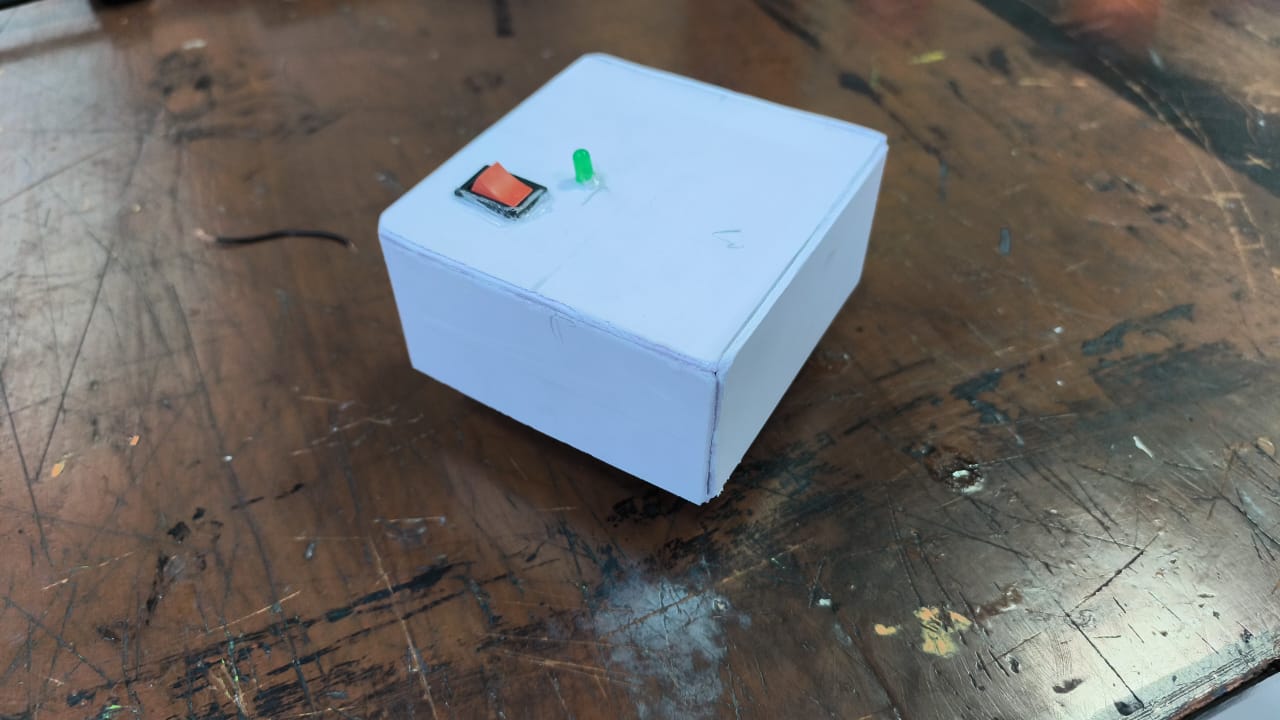
No physical UWB/RFID tags were available. We simulated tag behavior using ESP32 dev kits
and validated the full pipeline with mock APIs and pre-recorded CCTV footage. The system logic was
proven end-to-end; the hardware is ready to scale.
06 — My Role
Leading a mixed team of designers and developers
Research & Direction
I chose the brief, set the research direction, did the deep NCRB data analysis, mapped stakeholders,
identified cognitive behavior patterns by age group, and charted the entire problem space onto
physical boards before any digital work began.
Teaching & Alignment
In a mixed team of 4 designers and 3 developers, I bridged the gap — teaching developers how to think
in empathy maps and problem frames, while helping designers articulate technical constraints. Every
decision was made at the chart paper wall, not in Figma.
Presentation & Pitch
I delivered the final pitch to the jury. Opened with a hook referencing the movie Duvvada Jagannadham
— "don't let your kid become like DJ" — and walked them through the system logic. The jury cited my
presentation energy and the hook as standout moments.
Tools Used
Arduino + Arduino IDE, Visual Studio Code, Cursor, Google Docs, Google Scholar, FigJam, and most
importantly — chart paper, sticky notes, and markers for the hands-on research wall.
07 — Outcome
First place. Validated by industry experts.
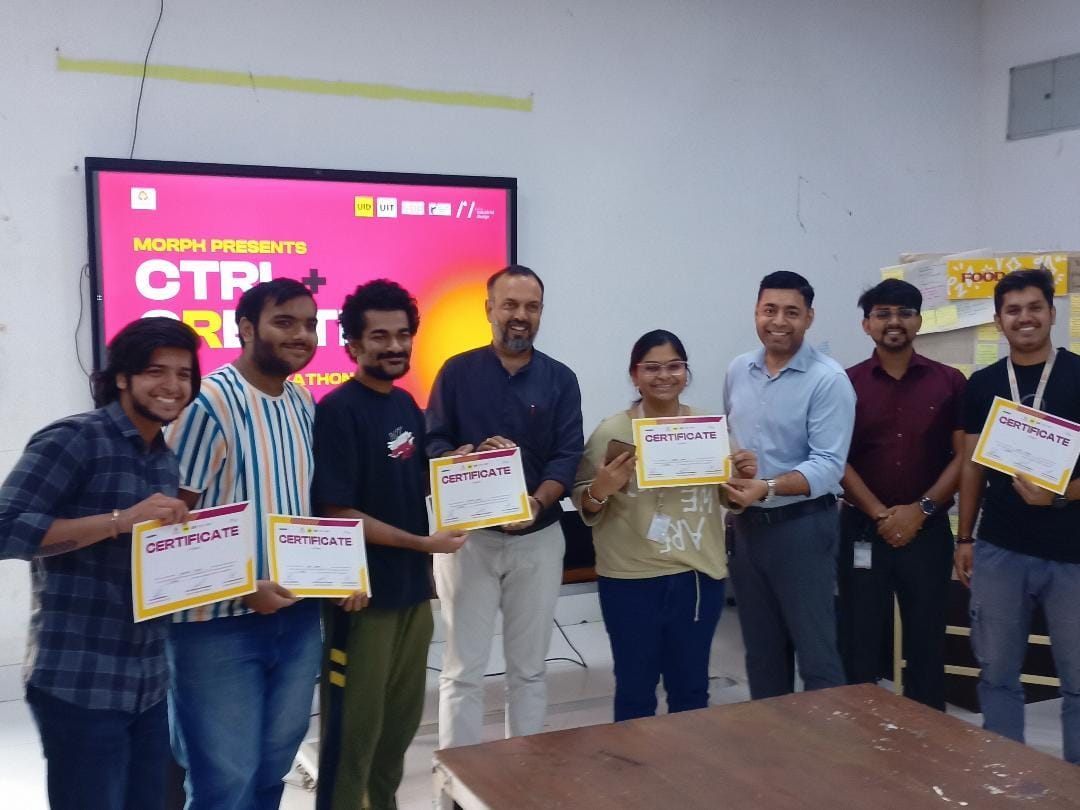
Tiny Traces won 1st place at CTRL+CREATE — a 48-hour hackathon at Karnavati University. The
jury validated the system's potential to save lives in high-density Indian infrastructure. The prize: ₹3,000
and the knowledge that a child safety ecosystem born in a hackathon could become a standard layer of
protection in public spaces.